© The Authors 2026. Published by Journal of Language Evolution.
This is an Open Access article distributed under the terms of the
Creative Commons Attribution License
, which permits unrestricted reuse, distribution, and reproduction in
any medium, provided the original work is properly cited.
Oxford University Press
https://doi.org/10.1093/jole/lzag001
Published 08 April, 2026
Research Article
OXFORD
Phylogenetic inference from cognate word forms
David M. Goldstein
1,*
,
Shawn H. McCreight
2
,
Éva Buchi
3
, and
John P. Huelsenbeck
4
1
Department of Linguistics,
University of California, Los Angeles, UCLA, Los Angeles, CA 90095-1543, USA
;
2
Nytril LLC
,
2904 Horsehead Bay Dr. NW, Gig Harbor, WA 98335, USA
;
3
Centre national de la recherche scientifique
, Nancy, FR
and
Université de Lorraine
, Nancy, FR
;
4
Department of Integrative Biology,
University of California, Berkeley, UC Berkeley,
Berkeley, CA 94720, USA
;
*
Corresponding author.
dgoldstein@humnet.ucla.edu
Linguistic phylogenies are commonly inferred from abstract cognate classifications that encode relationships
among lexemes. Although widespread, this practice has well-recognized limitations: it discards the
phylogenetic signal contained in segmental word forms; restricts the range of evolutionary questions that can
be addressed; and treats cognacy judgments, which are hypotheses, as observed data. We introduce a
comparative framework that addresses these limitations by modeling the evolution of aligned cognate word
forms directly. Our approach adapts the TKF91 model of molecular evolution, originally developed to account
for insertion and deletion events in DNA sequences, to the domain of linguistic data. By operating on
segmental strings rather than abstract character codings, the framework enables phylogenetic inference from
observable word forms and supports quantitative investigation of sound change. We demonstrate its utility
through analyses that illuminate patterns of segmental stability and the evolution of phonological inventories.
Keywords
Bayesian inference, Historical linguistics, Historical phonology, Phylogenetics, Romance
1. Introduction
Natural languages exhibit the property of descent with
modification, which allows their histories to be
represented as phylogenetic trees and inferred using
methods originally developed in evolutionary biology
(Atkinson and Gray
2005
; Croft
2008
; Pagel
2009
;
Borchsenius et al.
2017
; Bromham
2017
; Pagel
2017
)
. Over
the past two decades, such methods have become central
to historical and evolutionary linguistics. Bayesian
phylogenetic methods in particular are increasingly used
to infer tree topologies, ancestral states, and divergence
times
(Bouckaert et al.
2012
; Bowern and Atkinson
2012
;
Chang et al.
2015
; Kim et al.
2017
; Sagart et al.
2019
;
Carling and Cathcart
2021
; Auderset et al.
2023
; Heggarty
et al.
2023
)
. Despite the undeniable advances of these
methods, a foundational issue remains unresolved: the
nature of the observations. We argue that modeling
linguistic evolution as a sequence of explicit segmental
events yields richer and more coherent inferences than
current trait-based approaches.
1.1. Root-meaning traits
Most linguistic phylogenies are inferred from abstract
cognate relationships
(Gray and Jordan
2000
; Holden
2002
;
Ringe et al.
2002
; Gray and Atkinson
2003
; Bouckaert et al.
2012
; Bowern and Atkinson
2012
; Chang et al.
2015
)
.
Cognates are linguistic units at different levels (e.g.,
segments, morphemes, words) that share a common
ancestor. An example from the lexical domain is Spanish
mano
‘hand,’ French
main
, and Italian
mano
, which all
descend from Proto-Romance
*/manu/
. Four types of
lexical cognacy have been identified in the literature
(Chang et al.
2015
)
, but phylogenetic studies rely
overwhelmingly on one: root-meaning traits.
Root-meaning traits encode the ancestral
relationships of the root of the most semantically general
and stylistically neutral word associated with a given
concept, such as ‘hand’
(Heggarty et al.
2023
)
. The
concepts are drawn from a restricted subset of the lexicon
commonly referred to as the “basic vocabulary,” which
includes terms for body parts, basic actions, natural
phenomena, and other central domains of daily life that
are assumed to be comparatively resistant to borrowing
2
Phylogenetic inference from cognate word forms
Table
1
.
A root-meaning trait for the concept ‘hand.’
Language
Phonemic Representation
Cognate Class
English
/hænd/
0
German
/hant/
0
Dutch
/ɦɑnd/
0
French
/mɛ̃/
1
Spanish
/mano/
1
Italian
/mano/
1
Russian
/ruka/
2
Polish
/rɛŋka/
2
Lithuanian
/ranka/
2
and replacement. These basic vocabulary items are
typically organized into Swadesh lists, which now exist in
several versions
(Tadmor et al.
2010
)
.
Table
1
presents a root-meaning trait for the concept
‘hand’ in a sample of Indo-European languages. Lexical
items that descend from a common ancestor are grouped
into the same cognate class, with class membership
determined on the basis of regular sound correspondences.
The resulting multistate cognate classifications are
typically recoded as a set of binary characters, where 0 and
1 indicate the absence or presence, respectively, of a
lexeme belonging to a given cognate class. These binary
values constitute the observed data used for subsequent
phylogenetic inference.
Despite their widespread use, root-meaning traits
exhibit several well-known limitations. The most serious is
that the reduction of word forms to abstract cognate
classes results in substantial information loss. For example,
the lexemes for ‘hand’ in Spanish, French, and Italian are
assigned the same state in
Table
1
. Since this
representation exhibits no variation across these
languages, no inferences can be drawn about their
historical relationships. The segmental forms themselves,
however, preserve phylogenetic signal: French
/mɛ̃/
,
Spanish
/mano/
, and Italian
/mano/
each represent distinct
reflexes of Latin
/manum/
. Standard trait-based methods
in linguistic phylogenetics are not designed to incorporate
such fine-grained segmental divergence into the inference
process.
Second, since root-meaning traits are analyzed
analogously to morphological characters in biology
(Lewis
2001
)
, they inherit the same methodological constraints.
(i)
The state labels, whether binary or multistate, are
arbitrary and carry no intrinsic interpretation beyond
distinguishing cognate classes. Consequently, linguistic
phylogenetic analyses are effectively limited to models
with symmetric transition rates, so that the likelihood is
invariant to permutations of the state labels. That is, the
probability of the data must remain unchanged if 0s and 1s
are interchanged.
(ii)
Moreover, state labels are not
comparable across lexical items. State 0 for one concept
does not correspond to state 0 for another, which
precludes pooling information across characters to
estimate shared evolutionary dynamics.
(iii)
Invariant
root-meaning traits (those exhibiting a single state across
all languages) are relatively rare. Likelihood calculations
must therefore condition on the exclusion of constant
patterns from the data matrix. As a result, phylogenetic
analyses based on such traits are largely confined to
estimating tree topology and divergence times, while
providing limited access to the dynamics of segmental
change.
Third, recoding multistate cognate relationships as
binary characters induces statistical dependencies among
the resulting variables. For any given concept, the presence
of one cognate class in a language entails the absence of
the others, except in cases of polymorphism. However, the
continuous-time Markov models typically employed
assume that characters evolve independently and
identically distributed
(i.i.d.)
. Binary characters derived
from multistate cognate data violate this independence
assumption.
Finally, cognate-class assignments such as those in
Table
1
are treated as observed data, even though they are
inferred. Cognacy judgments are hypotheses about
ancestral relationships among lexical items and cannot be
observed any more than a phylogenetic tree can. This
practice sits uneasily with the principles of Bayesian
inference, under which posterior distributions are
conditioned on observable data. Our approach mitigates
this tension by conditioning inference on attested word
forms rather than abstract cognate classes. The selection of
word forms, however, remains guided by prior
assumptions of cognacy.
1.2. The TKF91 approach
We introduce an approach to linguistic
phylogenetics in which the observations are aligned
cognate word forms
(Bouchard-Côté et al.
2013
; Abner et
al.
2024
)
. The segmental evolution of these forms is
modeled as a continuous-time Markov process that
permits three types of instantaneous events:
(i)
substitution of one segment by another;
(ii)
insertion of a
segment;
(iii)
deletion of a segment. This framework
enables analysis in a manner directly analogous to
molecular phylogenetic inference. The model, first
introduced by
Thorne et al. (
1991
)
, is known in the
molecular evolution literature as TKF91. Just as nucleotides
are treated as equivalent states irrespective of genomic
position, our method treats segments as equivalent states
across words. This permits estimation of event rates by
pooling information across lexical items and segmental
positions. By operating directly on segmental strings, the
approach overcomes the principal limitations of trait-based
coding. It preserves segmental structure, avoids arbitrary
state labels, accommodates invariant data, and conditions
inference on observable word forms.
Phylogenetic inference from cognate word forms
3
Romanian
Portuguese
Spanish
Catalan
French
Walloon
Friulian
Italian
Fig
1
.
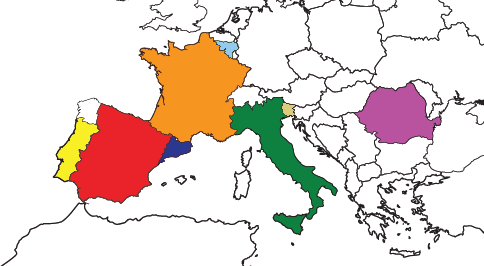
Approximate geographic distribution of the Romance languages in the study group.
Although the TKF91 model can be used for tree
estimation, we focus on its capacity to estimate rates of
change among segments, a central question in both
linguistic theory and phonological typology. Several
quantitative measures of diachronic segment stability have
been proposed
(Wichman
2009
; Moran and Verkerk
2018
;
Moran et al.
2021
)
, but these approaches are not embedded
within an explicit phylogenetic framework and do not
model segment-to-segment transitions. A key advantage of
our method is that it accommodates a broad class of
transition models unconstrained by arbitrary state codings.
We demonstrate the power of the TKF91 model with a
sample of eight Romance languages together with Latin.
The analysis yields three principal findings concerning
sound change from Latin to Romance. First, vowels exhibit
greater diachronic volatility than consonants. Second,
models that parameterize transition rates over
phonological natural classes provide a substantially better
fit than simpler alternatives. Third, the inferred
equilibrium frequencies indicate a disproportionate
representation of stops and short vowels in Romance
lexical forms relative to other segment classes.
The remainder of this paper is structured as follows.
Sections
2
and
3
describe the data and methodological
framework.
Section
4
presents the empirical results.
Section
5
situates these results within historical phonology
and phonological typology and compares our approach to
the other views of sound change.
Section
6
concludes with
a summary of the principal contributions and outlines
directions for further development of the TKF91 approach.
2. Data
The dataset consists of cognate word forms drawn from a
sample of eight Romance languages and Latin, whose
geographic distribution is presented in
Figure
1
. The word
forms are cognate in the traditional sense: they descend
from a common ancestor
(Chang et al.
2015
, p. 201)
. In
contrast to root-meaning traits (such as the one illustrated
in
Table
1
), cognacy does not depend on semantic
equivalence. For instance, the Latin adjective
gravis
means
‘heavy,’ but French
grave
means ‘serious.’ Despite this
semantic divergence, they are assigned to the same
cognate set because they are segmentally homologous.
Cognate sets were assembled as follows. We began
by identifying basic-vocabulary items in Latin using the
Swadesh 207-item list. Although cognates of any semantic
domain could in principle have been selected, the Swadesh
list was employed solely to minimize the likelihood of
borrowing. For each Latin lexeme, corresponding cognates
in the eight Romance languages were collected from
etymological dictionaries. Forms identified as borrowings,
whether from Latin or among Romance varieties, were
excluded. The decision to anchor the dataset in Latin was
motivated by practical considerations. Since we only used
complete cognate sets, beginning with Latin maximized
the chances of having cognates in all of the Romance
languages in our sample. (In principle, incomplete cognate
sets, i.e., those lacking a reflex in one or more languages,
could be incorporated. However, restricting the dataset to
complete sets simplifies parameter estimation and was
therefore adopted for this initial investigation.)
The dataset comprises 102 cognate sets, totaling 918
word forms and 79 distinct segments distributed across 98
concepts. Word forms may be represented either
phonetically or phonemically; in this study, we adopt
phonemic representations for two reasons. First, detailed
phonetic transcriptions are not consistently available,
particularly for a corpus language such as Latin. Second,
the current implementation of the model does not
accommodate within-language phonetic variation.
Accordingly, reliance on phonetic data would have
necessitated selecting a single, potentially arbitrary,
surface realization for each form. All representations are
strictly segmental. Suprasegmental properties, including
stress and syllable structure, are not encoded. Segments
are transcribed using standard Unicode IPA conventions
(International Phonetic Association
1999
)
.
Within each cognate set, word forms were manually
aligned. An illustrative example is provided in
Table
2
for
the concept
‘what.’
Dashes (‘-’) indicate the absence of a
segment homologous to one present in other forms. For
example, the
/i/
of Latin
/kʷ-id/
corresponds to
/wa/
in
French and Walloon. To represent the emergence of
/w/
,
an empty segmental position is introduced before the
vowel in the remaining languages. As discussed in
Section
3
, however, these manual alignments serve only as initial
configurations for the Markov chain Monte Carlo
4
Phylogenetic inference from cognate word forms
Table
2
.
Manual alignment of the words for the concept
‘what.’
Language
Phonemic Representation
Alignment
Latin
/kʷid/
kʷ
-
i
d
Romanian
/ʧe/
ʧ
-
e
-
Portuguese
/kɨ/
k
-
ɨ
-
Spanish
/ke/
k
-
e
-
Catalan
/kɛ/
k
-
ɛ
-
French
/kwa/
k
w
a
-
Walloon
/kwɛ/
k
w
ɛ
-
Friulian
/ʧe/
ʧ
-
e
-
Italian
/ke/
k
-
e
-
procedure. Inference does not condition on any fixed
alignment and the posterior distribution integrates over
alternative homology assignments. Accordingly, explicit
gap symbols are not required elements of the input.
Latin is a highly synthetic language in which most
lexical items exhibit multiple inflected forms. For purposes
of analysis, each lexical item in the dataset is represented
by a single form. Verbs are represented by the present
active infinitive. Nouns, adjectives, and pronouns are
represented by singular forms in either the accusative or,
less frequently, the nominative case, as these are the case
forms directly continued in the Romance languages. The
selection of citation form is not methodologically neutral,
as it can influence estimated transition rates. For example,
most masculine singular nominative adjectives in Latin
end in
/-us/
, whereas feminine singular nominative
adjectives end in
/-a/
. Systematic inclusion of feminine
forms would increase the number of transitions originating
in this vowel.
The lexical histories of the Romance languages are
complex
(Stefenelli
1992
; Dworkin
2016
)
, as they reflect not
only vertical inheritance but also substantial borrowing
both from within Romance and from Latin itself. Given
this non-tree-like component of their evolution, one might
question the suitability of Romance data for phylogenetic
modeling. In fact, Romance cognates are particularly well
suited to our objectives for two reasons. First, the dataset
is restricted to basic vocabulary, a domain in which
borrowing is relatively infrequent
(Tadmor et al.
2010
;
Carling et al.
2019
, p. 2)
. Second, the phonological
development of the Romance languages, which are
attested in written sources from as early as the 9
th
and 10
th
centuries, is sufficiently well understood that borrowings
and Latinisms can often be identified. All forms for which
evidence of borrowing was detected were excluded.
Romance cognates are thus appropriate for our analysis for
the same reason that the traditional comparative method
has successfully reconstructed Proto-Romance forms. For
example, the
Dictionnaire Étymologique Roman
(DÉRom
2008
)
reconstructs portions of the Proto-Romance lexicon
from a dataset comparable in scope and design to ours.
3. Methods
A comprehensive account of the model specification and
computational implementation is provided in the
Supplemental Material. The discussion here summarizes
the essential components of the framework and the
structure of the empirical analyses.
3.1. Model and Statistical Inference
We assume that the languages in our sample are related
by an unknown phylogenetic tree,
Ψ
=
(
τ
,
ν
)
, which
encodes both their branching structure
(
τ
)
and the
expected number of phonemic transition events
ν
along
each branch. Evolution of word forms along the tree is
modeled under TKF91
(Thorne et al.
1991
)
, an event-based
continuous-time process in which three instantaneous
operations are permitted: segmental substitution,
insertion, and deletion. Insertions and deletions occur at
rates
λ
and
μ
, respectively, subject to the constraint
λ
<
μ
.
Segmental substitution is modeled as a continuous-time
Markov process whose states correspond to phonemes (the
inventory comprises 79 distinct segments). All pairwise
substitution rates are specified by the rate matrix
Q
,
which is governed by parameters
θ
.
Parameter estimation is conducted within a Bayesian
framework, with inference based on the joint posterior
distribution of all model parameters:
f
(
Ψ
,
λ
,
μ
,
θ
|
S
)
=
f
(
S
|
Ψ
,
λ
,
μ
,
θ
)
f
(
Ψ
,
λ
,
μ
,
θ
)
f
(
S
)
(1)
S
denotes the observed segmental sequences of the
cognate word forms. The likelihood function,
f
(
S
|
Ψ
,
λ
,
μ
,
θ
)
, is evaluated using the dynamic
programming algorithm of
Lunter et al. (
2003
)
. Prior
distributions for most parameters follow conventions
standard in phylogenetic modeling. The insertion and
deletion rate parameters, however, are assigned
independent exponential priors subject to the constraint
λ
<
μ
. An alignment of length
L
is assigned a geometric
prior with parameter
λ
/
μ
. Under the TKF91 process, the
equilibrium distribution of alignment lengths is geometric
with parameter
λ
/
μ
, which motivates this choice. A more
principled alternative would specify a fully generative prior
over alignments conditional on the insertion and deletion
rates, derived directly from the TKF91 process. The
development of such priors for segmental homology
structures remains an important objective for future
research.
The posterior distribution is approximated
numerically using Markov chain Monte Carlo, or MCMC
(Metropolis et al.
1953
; Hastings
1970
)
. We construct a
Markov chain whose state space consists of the full set of
model parameters and whose stationary distribution
coincides with the posterior distribution of interest. After
Phylogenetic inference from cognate word forms
5
Table
3
.
Model: “Natural Class”
Long Vowel
eː
oː
uː
aː
iː
øː
Nasal Vowel
ɐ̃w
ɛ̃
ẽ
ɑ̃
ɐ̃
ɔ̃
õ
ĩ
ũ
œ̃
ɐ̃j
Diphthong
o̯a
ɨj
ɨw
ɔj
au̯
ej
ɛj
e̯a
aj
oj
ɐj
Short Vowel
o
i
a
ə
ɐ
ɔ
e
u
ɨ
y
ɛ
œ
ɑ
ø
Nasal Consonant
m
n
ɲ
ŋ
Liquid
l
ʎ
r
ɾ
ʁ
ʀ
Approximant
j
ɥ
w
Affricate
ʧ
ʦ
ʤ
Fricative
ʃ
x
v
f
s
h
ʝ
z
ʒ
θ
ɣ
Stop
d
k
c
p
b
t
ɡ
ɡʷ
kʲ
kʷ
convergence, the samples drawn from this chain constitute
dependent but valid draws from the posterior. In addition
to phylogenetic parameters, the MCMC algorithm jointly
samples segmental alignments
(Lunter et al.
2005
)
.
Segmental substitution is parameterized with
reference to phonological natural classes, which are
defined as sets of segments sharing phonetic features. The
segment inventory is exhaustively partitioned into ten
such classes, listed in
Table
3
. Under the Natural Class
model, transition rates are allowed to vary across these ten
classes. The model includes 79 parameters governing the
equilibrium distribution and 80 parameters specifying
exchange rates among natural classes. Equilibrium
frequencies are treated as random variables with a flat
Dirichlet prior.
3.2. Modeling linguistic history with
cognate word-forms
Working with cognate word forms presents specific
methodological challenges, most notably the alignment of
homologous segments across languages. In molecular
phylogenetics, fine-grained homology among nucleotides
is typically inferred using automated sequence-alignment
algorithms. Even with long nucleotide sequences, however,
alignment uncertainty can be substantial
(Wong et al.
2008
)
. This problem is amplified in lexical data, where word
forms often contain only a small number of segments. To
accommodate this uncertainty, we marginalize over
possible segmental alignments rather than conditioning on
a single fixed alignment. Concretely, all candidate
alignments are integrated over, each weighted by its
probability under the model. This integration is achieved
within a Bayesian framework using MCMC, which jointly
samples model parameters and segmental alignments in
proportion to their posterior probabilities.
3.3. Models of segmental change
We evaluate three models of segmental change.
M
1
is
isomorphic to the Jukes-Cantor model of DNA sequence
evolution
(Jukes and Cantor
1969
)
, which specifies equal
transition rates among all pairs of states, with
substitutions occurring according to a Poisson process
(hereafter the ‘Poisson’ model).
M
2
, corresponds to the
Felsenstein model
(Felsenstein
1981
)
, in which the
substitution rate from one segment to another is
proportional to the equilibrium frequency of the
destination segment. Finally,
M
3
, the Natural Class model,
partitions segments into articulatorily defined natural
classes and permits distinct rates of change within and
between these classes. Model complexity differs
substantially across these specifications.
M
1
contains no
free parameters.
M
2
includes 78 free parameters
corresponding to the equilibrium frequencies (one fewer
than the number of segments). The Natural Class model,
M
3
, has 55 additional rate parameters governing
transitions among natural classes, which yields a total of
78
+
55
=
133
free parameters.
3.4. Data Curation and Analysis
All analyses are orchestrated by a control program
written in the Nytril programming language
(McCreight
and Colbert
2024
)
. We developed an automated
experimental pipeline comprising a reusable IPA library,
curated word-form datasets, data-validation routines,
typeset output generation, and input-file construction for
the MCMC engine, which is implemented in C++.
Word forms from the nine languages are organized
hierarchically by concept and cognate class.
Figure
2
illustrates the raw encoding for the concept ‘Night.’ A
central technical challenge arises from the fact that IPA
transcriptions are encoded in Unicode (UCS), which
cannot be represented in single-byte encodings such as
ASCII. Accordingly, all data are stored in UTF-8, a
cross-platform multibyte encoding of UCS. To ensure
reliable string comparison, diacritic composition must be
standardized; we adopt Unicode Normalization Form C,
although consistency across files is the critical
requirement. Moreover, a single IPA segment may consist
of multiple UCS code points, so the correspondence
between characters and phonological segments is not
one-to-one.
Figure
3
provides an example of a complex encoding
in which the grey numerals indicate hexadecimal UCS
code points for base characters and diacritics. Since the
analysis operates at the segmental level, a parser converts
each word string into an array of segment objects. These
objects are implemented in a reusable library that
associates each segment with linguistic features.
Subsequent processing steps operate on abstract properties
such as ‘vowel’ and ‘nasal,’ rather than on raw character
strings.
Following parsing, the control program aggregates
and partitions the data and generates the input required
for Bayesian inference under the TKF91 model. The
MCMC analysis runs for 5,000,000 cycles, with
independent runs performed to assess convergence.
Samples taken during the first 15,000 cycles of the chain
6
Phylogenetic inference from cognate word forms
namespace
Night
{
Confidence
=
10;
WordType
=
WordTypes
.
Noun
;
WordGroup
=
Leipzig
Swadesh100
Swadesh207
;
namespace
Primary
{
Latin
=
"n-octem"
;
// nox
French
=
"nɥi----"
;
// nuit SHOULD ɥi BE A DIPHTHONG?
Spanish
=
"n-o-ʧe-"
;
// noche
Italian
=
"n-ɔtte-"
;
// notte
PortugueseB
=
"n-oj-ti-"
;
// noite
Portuguese
=
"n-oj-tɨ-"
;
// noite
Catalan
=
"n-i-t--"
;
// nit
Walloon
=
"n-y-t--"
;
// nute
Friulian
=
"ɲ-ɔ-t--"
;
// gnòt
Romanian
=
"n-o̯apte-"
;
// noapte
}
}
Fig
2
.
The concept
‘night’
as coded in the data file.
tɹ̝̊
0074, 0279, 031d, 030a
Alveolar Pulmonic Affricate
Fig
3
.
The IPA-Unicode encoding of a segment.
are discarded as burn-in. Upon completion, posterior
samples are imported back into the control program for
post-processing. All tables, trees, and graphical outputs are
generated automatically from the MCMC results and
integrated with author-supplied narrative to produce the
final manuscript and supplementary materials.
4. Results
4.1. Phylogeny
All model parameters are treated as random
variables endowed with prior distributions. The tree
topology describing the relationships of the languages is
likewise modeled as a random variable under a uniform
prior over all possible topologies. As outlined in
Section
3.1
,
the posterior probability distributions of the model
parameters are numerically approximate with MCMC.
Across runs, a small set of topologies consistently achieved
the highest posterior support. However, the MCMC
sampler exhibited limited mixing over tree space: once a
high-probability topology was located, the chain tended to
remain trapped in its vicinity.
In our implementation, parameters are updated in
blocks, with each MCMC step randomly selecting a single
component and proposing a modification to it. Within a
given cycle, either the tree topology or the segmental
alignment is updated, but not both simultaneously. This
update scheme induces dependence between topology and
alignment. As improved topologies were accepted, the
sampled alignments increasingly adapted to the current
tree stored in memory. Once the alignment became
well-tuned to a particular topology, proposals involving
alternative trees were rarely accepted, even when they
would have been plausible under a different alignment
configuration.
This difficulty does not appear to have arisen in
earlier applications of TKF91
(Lunter et al.
2005
)
, which
analyzed an alignment of amino acid sequences. Our
analysis of cognate data yielded insertion and deletion
rates that were large relative to substitution rates:
λ
=
0.243
(0.217, 0.273) and
μ
=
0.298
(0.266, 0.335),
respectively. (Each credible interval contains the true
parameter value with probability 0.950.) In approximate
terms, this implies one insertion or deletion event for every
two substitution events. Like substitution events, insertion
and deletion events contribute phylogenetic signal. In
contrast to the earlier analysis of amino acid sequence
data, the insertion and deletion events exerted substantial
influence on tree support and their contribution varied
with the sampled homology assignments.
Subsequent analyses therefore condition on the three
fixed topologies in
Figure
4
. Although the diversification of
Romance remains debated, many recent accounts posit
Sardinian as the earliest branching lineage, followed by
Romanian
(Hall
1950
; Hall
1976
; De Dardel
1985
; Swiggers
2001
; Vallejo
2012
; Buchi et al.
2015
; Dworkin
2016
)
. Since
Sardinian is not in our sample, Romanian occupies the
earliest branching position in each topology in
Figure
4
.
The internal structure of the subtrees varies across the
three configurations, but Spanish and Portuguese
consistently form a clade, as do Catalan, French, and
Walloon.
The relationship between Classical Latin, Vulgar
Latin, Proto-Romance, and the Romance languages
remains the subject of ongoing debate
(Posner
1996
; Harris
and Vincent
2003
; Chang et al.
2015
; Heggarty et al.
2023
;
Goldstein
2024
)
. A central issue is whether Latin (Classical
or Vulgar) is a sampled ancestor of the Romance languages
or their sister lineage. For reasons of model tractability, we
adopt the latter assumption and treat Latin as an
outgroup. Tree models that incorporate sampled ancestors
are considerably more complex than the framework
employed here. This modeling choice does not exclude an
ancestral interpretation, however: if the estimated branch
length leading to Latin approaches zero, Latin is effectively
positioned at the root of the Romance clade.
4.2. Model Comparison
We assessed the relative fit of the three segmental-change
models introduced in
Section
3
using Bayes factors. The
Bayes factor is the ratio of the marginal likelihoods of the
models:
BF
=
f
(
S
|
M
i
)
f
(
S
|
M
j
)
f
(
S
|
M
j
)
(2)
Ratios greater than one indicate evidence in favor of model
M
i
. Since the candidate models are nested, we computed
the Bayes factor via the Savage-Dickey density ratio
(Dickey
1971
)
, which evaluates the ratio of posterior to
prior densities at the parameter restriction that reduces
Phylogenetic inference from cognate word forms
7
Tree 1
Latin
Romanian
Italian
Friulian
Portuguese
Spanish
Catalan
French
Walloon
Tree 2
Latin
Romanian
Friulian
Italian
Portuguese
Spanish
Catalan
French
Walloon
Tree 3
Latin
Romanian
Portuguese
Spanish
Catalan
French
Walloon
Friulian
Italian
Fig
4
.
Model trees used in all analyses
Rate
ɨw
ɨj
ɐj
ej
aj
ɔj
oj
ɛj
au̯
e̯a
o̯a
øː
uː
oː
eː
iː
aː
ʦ
ʤ
ʧ
ɑ
y
ø
œ
ɐ
ɨ
ɔ
ɛ
ə
a
o
i
u
ũ
œ̃
ɐ̃j
ɐ̃w
e
ɐ̃
õ
ĩ
ẽ
ɔ̃
ɛ̃
ɑ̃
ʀ
ʎ
l
ʁ
ɾ
ɥ
j
w
ɣ
r
h
θ
ʒ
ʝ
x
z
f
v
ʃ
s
ŋ
ɲ
n
m
ɡʷ
kʲ
kʷ
c
p
ɡ
d
b
t
k
0
1
2
3
4
Diphthong
Long Vowel
Affricate
Short Vowel
Nasal Vowel
Liquid
Approximant
Fricative
Nasal Consonant
Stop
Fig
5
.
The rate of change when in a particular segmental state (or
−
q
ii
)
the richer model to the simpler one. The Natural Class
model explains the data substantially better than the two
simpler alternatives. The log Bayes factors are
ln
BF
12
= −
1074.2
and
ln
BF
23
= −
117.3
, comparing
M
1
to
M
2
and
M
2
to
M
3
, respectively. This difference
constitutes overwhelming support for the more
parameter-rich Natural Class model
(Jeffreys
1939
)
.
4.3. Segmental Change
Figure
5
presents the absolute values of the diagonal
entries of the substitution rate matrix estimated under the
Natural Class model. These diagonal elements provide a
measure of segmental volatility, as each diagonal element
equals the sum of transition rates from a given segment to
all alternative segments. When the process is in segment
i
,
the value
−
q
ii
represents the instantaneous rate at which
it changes state. Higher values therefore correspond to
shorter expected residence times and greater diachronic
instability. Several segmental classes in
Figure
5
appear to
share identical rates (e.g., diphthongs, long vowels,
affricates, and nasal vowels). This visual uniformity is an
artifact of scale rather than exact equality. Although the
rates in these classes are distinct, they are sufficiently
small to be indistinguishable at the resolution of the plot.
The most salient pattern in
Figure
5
is the clear
separation between vowels and consonants. With the
exception of affricates, vowels exhibit the highest
volatility, and within the vocalic domain diphthongs and
long vowels are particularly unstable. By contrast, the
most stable segments are consonants, with stops
displaying the lowest overall rates of change. Rates also
cluster tightly within natural classes: long vowels,
affricates, fricatives, short vowels, nasal vowels, nasal
consonants, and stops each form coherent groups. Two
segments depart from this pattern: the liquid
/r/
, which
clusters with the fricatives, and the mid-front vowel
/e/
,
which patterns with the nasal vowels. These patterns arise
from the interaction between class-specific exchangeability
parameters and the distribution of equilibrium frequencies.
When equilibrium frequencies are relatively homogeneous
within a class, the corresponding
−
q
ii
values tend to be
similar. The clustering observed in
Figure
5
thus reflects
both the structural constraints of the model and
regularities present in the empirical data.
Figure
6
displays the estimated equilibrium
frequencies under the Natural Class model
M
3
. These
frequencies enter the likelihood in two ways. First, they
determine the prior distribution over segmental states at
the root of the tree. Second, in models
M
2
and
M
3
, they
scale substitution rates so that transitions into a segment
are proportional to its equilibrium frequency. Accordingly,
8
Phylogenetic inference from cognate word forms
π
0.0
0.1
0.2
0.3
0.4
Stop
Fricative
Affricate
Approximant
Liquid
Nasal Consonant
Short Vowel
Diphthong
Nasal Vowel
Long Vowel
Fig
6
.
The equilibrium frequencies
π
of each natural class
transitions into
liquids
(
0.188
),
short vowels
(
0.110
), and
nasal consonants
(
0.0758
)
exhibit the highest estimated
rates, which reflects their comparatively large equilibrium
weights. More broadly, the inferred equilibrium
distribution closely mirrors the empirical segment
frequencies observed in the dataset.
Figure
7
shows the estimated substitution rates
among the 10 groups of the Natural Class model.
Within-class exchange rates are elevated for short vowels,
nasal consonants, and liquids. Relative to an equal-rates
Poisson model, the within-class rates are
0.33, 1.63, 0.05,
8.59, 5.91, 14.70, 0.90, 0.52, 2.28, and 1.52
times larger for
long vowels
,
nasal vowels
,
diphthongs
,
short vowels
,
nasal
consonants
,
liquids
,
approximants
,
affricates
,
fricatives
,
and
stops
, respectively. Thus within-class exchange falls
below the equal-rates expectation for long vowels,
diphthongs, approximants, and affricates, while it exceeds
expectation for nasal vowels, short vowels, nasal
consonants, liquids, fricatives, and stops. Exchange rates
between long vowels and short vowels, and between
diphthongs and short vowels, exceed the corresponding
within-class rates, a tendency discussed in section 5.2
below. Overall,
60.0
% (6 out of 10) of within-class
transitions exceed the equal-rates expectation, compared
to
23.3
% (21 out of 90) of transitions between distinct
classes. This asymmetry indicates that, although not
universal across classes, substitution rates are more
frequently higher within natural classes than between
them. This asymmetry reinforces the conclusion that
segments are more likely to change within their own
natural class than across class boundaries.
4.4. Segmental Alignments
In our framework, segmental homology across languages is
treated as a latent random variable. Posterior uncertainty
over alignments is summarized by constructing a credible
set for each cognate word form. Alignments are ordered by
posterior probability and the smallest set whose
cumulative posterior mass reaches 0.95 is retained.
Figure
8
illustrates this procedure for the concept
‘flower’
. Three
general properties emerge. First, posterior mass is typically
concentrated on a single dominant alignment. In the
example shown, the highest-probability alignment alone
accounts for
0.79
of the posterior. Second, insertion and
deletion events occur disproportionately in word-final
position, consistent with the distribution of gap
frequencies shown in
Figure
9
. Third, segments from the
same natural class tend to be assigned to the same column
in the alignment.
The posterior distribution over alignments is
sensitive to the substitution model.
Figure
10
presents the
95% credible set of alignments for the concept
‘sky’
under
the
Poisson
and
Natural Class
models. Under the
Poisson
model, the credible set contains 1,363 alignments under
the
Poisson
, whereas under the
Natural Class
model it
contains only 226 alignments under the
Natural Class
. This
reduction in alignment uncertainty accords with the
substitution-rate structure estimated under the
Natural
Class
model (
Figure
7
). For instance, transitions between
/
u/
and
/o/
are assigned relatively high rates, whereas
substitutions between consonants and
/o/
are strongly
disfavored. Consequently, the
Poisson
model frequently
aligns consonants with
/o/
, while such configurations
receive negligible posterior weight under the
Natural Class
model.
5. Discussion
5.1. Event-Based Modeling of Sound
Change: The TKF91 Approach
Theories of sound change exhibit substantial differences in
their assumptions about units and mechanisms. One
influential tradition treats phonemes as the primary units
of change
(Bloomfield
1933
)
. Under this view, sound
change is abrupt and non-independent. For instance, a
transition from
/a/
to
/o/
proceeds without intermediate
stages and the shift is conceived as a single systemic event
affecting all relevant lexical items simultaneously. Other
approaches emphasize the role of phonetic factors,
particularly acoustic and perceptual pressures, in driving
change
(Ohala
2003
; Blevins
2004
; Ohala
2012
)
, while still
others argue that sound change diffuses gradually through
the lexicon in a process known as lexical diffusion
(Chen
and Wang
1975
; Phillips et al.
2015
)
.
The TKF91 framework does not align fully with any
single tradition, though it shares features with both
phoneme-based accounts and lexical diffusion. Since the
observations are phonemic strings, insertions, deletions,
and substitutions operate over phonemes. Unlike classical
historical models, however, changes are not treated as
globally synchronized events. A shift from
/a/
to
/o/
is not
modeled as a single transformation applied uniformly
Phylogenetic inference from cognate word forms
9
Long Vowel
Nasal Vowel
Diphthong
Short Vowel
Nasal Consonant
Liquid
Approximant
Affricate
Fricative
Stop
Long Vowel
Nasal Vowel
Diphthong
Short Vowel
Nasal Consonant
Liquid
Approximant
Affricate
Fricative
Stop
Fig
7
.
The average rates of change between and within the ten groups of the Natural Class model. Circle area is
proportional to the rate of change between groups (
q
ij
). Shaded area represents the 95% credible interval.
across the lexicon. Instead, a substitution rate is inferred
from the observed homologies, which captures how
frequently
/a/
transitions to
/o/
across cognate sets. In this
respect, sound change is modeled as a stochastic process
operating independently across lexical items.
Our use of TKF91 parallels the approach of
Bouchard-Côté et al. (
2013
)
, who likewise treat cognate
word forms as the observed data. Their framework
employs a string transducer model
(Holmes and Bruno
2001
)
to characterize segmental correspondences, which
thereby accommodates context-dependent processes. By
contrast, the current implementation of TKF91 does not
incorporate contextual conditioning. Its advantage lies
elsewhere: TKF91 is an explicitly historical, event-based
model in which insertion, deletion, and substitution are
well-defined stochastic events. The likelihood integrates
over all possible sequences of such events that could have
generated the observed forms in the nine languages. Since
these events are parameterized by estimable rates, the
model provides a direct quantitative account of segmental
evolution. Even though it does not yet capture contextual
phonological processes, its event-based structure offers a
principled foundation for modeling sound change.
A practical limitation of TKF91 is computational
complexity. Likelihood evaluation scales exponentially
with the number of taxa and word length, with complexity
on the order of
O
(2
N
L
N
)
, where
N
denotes the number of
tips and
L
the geometric mean word length
(Lunter et al.
2003
)
. For linguistic datasets, this burden is mitigated by
the brevity of word forms, typically
1
≤
L
≤
10
.
Nevertheless, alternative formulations can reduce
computational cost. If insertion events are assumed to
occur independently of word length, rather than at rate
λ
(
L
+
1)
as in TKF91, the likelihood becomes linear in the
number of taxa
(Bouchard-Côté and Jordan
2013
)
. This
variant, known as the Poisson Indel Process (PIP), may be
preferable for datasets comprising substantially larger
language samples. Given that sampled alignments in our
analyses exhibit comparable lengths, PIP constitutes a
plausible direction for scaling the framework to broader
comparative datasets.
5.2. Implications for Sound Change
and Phonological Typology
Traditional historical phonology is primarily concerned
with identifying individual sound changes and establishing
their relative chronology. By contrast, the TKF91
framework permits inference about broader systemic
tendencies in the evolution of segmental inventories. We
focus on three quantities that illuminate these tendencies:
the diagonal elements of the substitution rate matrix,
transition rates within and between natural classes, and
the equilibrium distribution of segments. These quantities
provide a quantitative characterization of sound change
within an explicit phylogenetic model.
As discussed in
Section
3
, the diagonal entries of the
Q matrix measure the instantaneous rate at which a
segment transitions to any other state, and thus provide
10
Phylogenetic inference from cognate word forms
Probability
1
3
5
7
9
11
13
16
0.0
0.2
0.4
0.6
0.8
1.0
Latin
Romanian
Portuguese
Spanish
Catalan
French
Walloon
Friulian
Italian
0.789
f
l
oː
r
e
m
f
l
o̯a
r
e
-
f
l
o
ɾ
-
-
f
l
o
ɾ
-
-
f
l
ɔ
-
-
-
f
l
œ
ʁ
-
-
f
l
œ
r
-
-
f
l
oː
r
-
-
f
j
o
r
e
-
0.0153 (0.804)
f
l
-
oː
r
e
m
f
l
-
o̯a
r
e
-
f
l
-
o
ɾ
-
-
f
l
-
o
ɾ
-
-
f
l
-
ɔ
-
-
-
f
l
-
œ
ʁ
-
-
f
l
-
œ
r
-
-
f
l
-
oː
r
-
-
f
-
j
o
r
e
-
0.0147 (0.819)
f
l
oː
r
e
m
f
l
o̯a
r
e
-
f
l
o
ɾ
-
-
f
l
o
ɾ
-
-
f
l
-
ɔ
-
-
f
l
œ
ʁ
-
-
f
l
œ
r
-
-
f
l
oː
r
-
-
f
j
o
r
e
-
0.0133 (0.832)
f
-
l
oː
r
e
m
f
-
l
o̯a
r
e
-
f
-
l
o
ɾ
-
-
f
-
l
o
ɾ
-
-
f
-
l
ɔ
-
-
-
f
-
l
œ
ʁ
-
-
f
-
l
œ
r
-
-
f
-
l
oː
r
-
-
f
j
-
o
r
e
-
0.0125 (0.844)
f
l
oː
-
r
e
m
f
l
-
o̯a
r
e
-
f
l
-
o
ɾ
-
-
f
l
-
o
ɾ
-
-
f
l
-
ɔ
-
-
-
f
l
-
œ
ʁ
-
-
f
l
-
œ
r
-
-
f
l
-
oː
r
-
-
f
j
-
o
r
e
-
0.0120 (0.856)
f
l
-
oː
r
e
m
f
l
o̯a
-
r
e
-
f
l
o
-
ɾ
-
-
f
l
o
-
ɾ
-
-
f
l
ɔ
-
-
-
-
f
l
œ
-
ʁ
-
-
f
l
œ
-
r
-
-
f
l
oː
-
r
-
-
f
j
o
-
r
e
-
0.0113 (0.868)
f
l
oː
-
r
e
m
f
l
-
o̯a
r
e
-
f
l
o
-
ɾ
-
-
f
l
o
-
ɾ
-
-
f
l
ɔ
-
-
-
-
f
l
œ
-
ʁ
-
-
f
l
œ
-
r
-
-
f
l
oː
-
r
-
-
f
j
o
-
r
e
-
0.00903 (0.877)
f
l
-
oː
r
e
m
f
l
o̯a
-
r
e
-
f
l
-
o
ɾ
-
-
f
l
-
o
ɾ
-
-
f
l
-
ɔ
-
-
-
f
l
-
œ
ʁ
-
-
f
l
-
œ
r
-
-
f
l
-
oː
r
-
-
f
j
-
o
r
e
-
0.00834 (0.885)
f
l
oː
r
-
e
m
f
l
o̯a
r
e
-
-
f
l
o
ɾ
-
-
-
f
l
o
ɾ
-
-
-
f
l
ɔ
-
-
-
-
f
l
œ
ʁ
-
-
-
f
l
œ
r
-
-
-
f
l
oː
r
-
-
-
f
j
o
r
e
-
-
0.00700 (0.892)
f
l
oː
r
e
-
m
f
l
o̯a
r
-
e
-
f
l
o
ɾ
-
-
-
f
l
o
ɾ
-
-
-
f
l
ɔ
-
-
-
-
f
l
œ
ʁ
-
-
-
f
l
œ
r
-
-
-
f
l
oː
r
-
-
-
f
j
o
r
-
e
-
0.00689 (0.899)
f
l
oː
r
e
m
-
f
l
o̯a
r
-
-
e
f
l
o
ɾ
-
-
-
f
l
o
ɾ
-
-
-
f
l
ɔ
-
-
-
-
f
l
œ
ʁ
-
-
-
f
l
œ
r
-
-
-
f
l
oː
r
-
-
-
f
j
o
r
-
-
e
0.00591 (0.905)
f
l
oː
r
e
m
f
l
o̯a
r
-
e
f
l
o
ɾ
-
-
f
l
o
ɾ
-
-
f
l
ɔ
-
-
-
f
l
œ
ʁ
-
-
f
l
œ
r
-
-
f
l
oː
r
-
-
f
j
o
r
-
e
0.00394 (0.909)
f
l
oː
r
-
e
m
f
l
o̯a
-
r
e
-
f
l
o
-
ɾ
-
-
f
l
o
-
ɾ
-
-
f
l
ɔ
-
-
-
-
f
l
œ
-
ʁ
-
-
f
l
œ
-
r
-
-
f
l
oː
-
r
-
-
f
j
o
-
r
e
-
0.00383 (0.913)
f
l
oː
r
-
e
m
f
l
o̯a
r
e
-
-
f
l
o
ɾ
-
-
-
f
l
o
ɾ
-
-
-
f
l
ɔ
-
-
-
-
f
l
œ
ʁ
-
-
-
f
l
œ
r
-
-
-
f
l
oː
r
-
-
-
f
j
o
r
-
e
-
0.00371 (0.916)
f
l
oː
r
-
e
m
f
l
o̯a
r
-
e
-
f
l
o
ɾ
-
-
-
f
l
o
ɾ
-
-
-
f
l
-
-
ɔ
-
-
f
l
œ
ʁ
-
-
-
f
l
œ
r
-
-
-
f
l
oː
r
-
-
-
f
j
o
r
-
e
-
0.00314 (0.920)
f
l
oː
r
e
-
m
f
l
o̯a
r
-
e
-
f
l
o
ɾ
-
-
-
f
l
o
ɾ
-
-
-
f
l
ɔ
-
-
-
-
f
l
œ
ʁ
-
-
-
f
l
œ
r
-
-
-
f
l
oː
r
-
-
-
f
j
o
r
e
-
-
Fig
8
.
Segments are colored according to natural class. Dashes denote gaps where there is no homologous segment for the
alignment position. The alignments are ordered from the highest posterior probability (top-left alignment) to the lowest
posterior probability (bottom-right alignment) in row order.
an index of diachronic stability. The pronounced
separation between vowels and consonants in
Figure
5
aligns with established findings in Romance historical
phonology. Among the major developments distinguishing
Latin from the Romance languages is the loss of phonemic
vowel length
(Janson
1979
; Loporcaro
2015
)
and the early
monophthongization of Classical Latin diphthongs
(Posner
1996
, p. 106)
. More broadly, our results accord with
evidence that vowel inventories have evolved more rapidly
than consonant inventories within Indo-European
(Moran
et al.
2021
, pp. 92-95)
.
The present findings also intersect with work in
phonological typology that seeks to identify core or stable
segment inventories. The basic consonant inventory
proposed by
Nikolaev and Grossman (
2020
)
,
/p t k n l r/
, is
consistent with our results insofar as stops and nasals
emerge as among the most stable classes. An even closer
correspondence is found with the set of primal consonants
identified by
Bybee and Easterday (
2022
)
,
/p t k b d g m n ŋ
s l/
. Two distinctions, however, are crucial. First, primal
consonants are defined in terms of their rarity as outputs
of sound change, whereas the diagonal of the Q matrix
measures the rate of transition away from a segment—that
is, its stability as an input to change. Second, typological
proposals aim to identify cross-linguistic universals,
whereas our estimates characterize tendencies within
Romance. The results therefore inform typological debates,
but should not be interpreted as cross-linguistic universals.
The average rates summarized in
Figure
7
provide a
complementary perspective on segmental stability by
comparing transitions within and between natural classes.
Within-class rates exceed cross-class rates for short
vowels, nasal consonants, and liquids. Liquids display the
highest within-class rates, whereas diphthongs exhibit the
lowest. A liquid is thus more likely to change into another
liquid than into a segment of a different class, a pattern
plausibly associated with processes such as liquid
dissimilation, e.g., Latin
arbor
> Spanish
árbol
(
Abrego-Collier
2013
; Müller
2013
)
. Transition rates
between diphthongs and short vowels are the highest
among all between-class rates, which is consistent with the
reciprocal effects of vowel breaking and
monophthongization in the history of Latin and Romance.
More generally, the largest off-diagonal rates involve
vowel classes, which reinforces the broader pattern of
vocalic instability identified above. Elevated rates between
nasal vowels and nasal consonants further reflects the
development of nasalized vowels in French and
Portuguese.
The equilibrium frequencies in
Figure
6
illuminate
the distributional consequences of these historical
processes. Short vowels and stops together account for
more than half of all segments, which indicates a
pronounced skew toward these classes. This distribution
reflects the reduction of diphthongs and long vowels and
Phylogenetic inference from cognate word forms
11
Proportion of Alignments
Word-initial seg.
0
1
2
3
4
5
6
7
8
9
0.0
0.2
0.4
0.6
0.8
1.0
Word-internal seg(s)
0
1
2
3
4
5
6
7
8
9
0.0
0.2
0.4
0.6
0.8
1.0
Word-final seg.
0
1
2
3
4
5
6
7
8
9
0.0
0.2
0.4
0.6
0.8
1.0
Number of Gaps
Fig
9
.
Distribution of alignment gaps across word
positions for the 102 cognate sets analyzed in this study.
The top panel shows the proportion of alignments with a
given number of gaps at the word-initial segment, the
middle panel at word-internal segments, and the bottom
panel at the word-final segment. Since nine languages are
analyzed, at most eight gaps can occur at a given position:
a deletion event affecting all nine languages would not
appear in the alignment and is explicitly conditioned on in
the likelihood calculation
(Lunter et al.
2003
)
. Gaps
increase systematically from initial to final position, with
word-final segments exhibiting substantially higher
deletion rates. A likelihood-ratio test rejects the null
hypothesis that the gap distributions are identical across
positions, (
χ
2
=
425.62
,
d.f.
=
16
,
p
<
0.001
), which
confirms a statistically significant positional asymmetry.
the concomitant expansion of short vowels within
Romance.
Finally, model comparison provides quantitative
support for the role of natural classes in sound change
(King
1969
, p. 201)
. Sound change frequently targets
segments that share articulatory or acoustic properties, as
exemplified by Grimm’s Law, which systematically
affected the Proto-Germanic reflexes of Proto-
Indo-European stops. The superior fit of the natural-class
model thus reinforces the long-standing view that
phonetic grounding constrains the trajectory of
phonological change.
5.3. Segmental Sampling
Under our framework, a new issue emerges: segmental
sampling
(Dockum and Bowern
2019
)
. Specific sound
changes can be pivotal for recovering tree topology, yet a
dataset assembled on the basis of a Swadesh list does not
ensure that such diagnostic patterns are adequately
represented. For instance, Romanian merges
Proto-Romance
*/ɔ/
and
*/o/
to
/o/
and
*/ʊ/
and
*/u/
to
/u/
.
By contrast, Italo-Western Proto-Romance (the common
ancestor of the remaining languages in our sample) merges
*/ʊ/
and
*/o/
to
/o/
. Consequently, Latin
buccam
‘mouth’
and Romanian
bucă
preserve
/u/
against the
/o/
reflex
found, for instance, in Italian
bocca
. This change
constitutes key evidence for the placement of Romanian
within the Romance tree
(Janson
1979
, p. 25; Herman
2000
,
pp. 32-34)
. If such correspondences are underrepresented
in the sample, the topology may be estimated incorrectly.
A related issue concerns the representativeness of the
segment-frequency distributions in
Figure
11
. These
distributions are derived from word forms sampled under
specific selection criteria and may not faithfully
approximate the segment frequencies of each language.
Systematic discrepancies of this kind can bias estimates of
substitution rates and, in turn, influence inferences about
sound-change dynamics and phylogenetic structure.
5.4. Limitations of the Model
The results reported here are derived from a model in
which segmental change is represented as a sequence of
independent insertion, deletion, and substitution events
operating on individual segments. As a consequence,
certain types of sound change are not naturally
accommodated within this framework. Metathesis, for
example—where two segments exchange positions—is not
modeled as a single transition. Friulian
/tarɔnt/
ultimately
derives from Latin
/rotundum/
‘round’, with the initial
Latin sequence
/rVt/
corresponding to
/tVr/
in Friulian.
Under TKF91, such a change is represented as two
independent substitutions (
/r/
→
/t/
and
/t/
→
/r/
), rather
than as a single reordering event. A second limitation
concerns contextual conditioning: transition rates are
estimated independently of phonological environment,
even though segmental change is often sensitive to
adjacent sounds. Finally, the current implementation does
not incorporate suprasegmental structure. Features such as
stress, which are known to be central to Romance
phonological developments, are therefore excluded from
the model.
5.5. Advantages of the Event-Based
Approach
Despite these limitations, the event-based formulation
offers distinct advantages. Since segmental change is
modeled explicitly as a stochastic process, it becomes
possible to investigate questions that are difficult to
address within traditional frameworks. For example, one
may ask whether the frequency of a phoneme influences
its diachronic stability, how rates of change depend on the
size and composition of a phonemic inventory, or to what
extent natural classes constrain evolutionary trajectories.
12
Phylogenetic inference from cognate word forms
M
1
— Poisson
Probability
1
2
3
4
5
6
7
8
0.0
0.2
0.4
0.6
0.8
1.0
Latin
Romanian
Portuguese
Spanish
Catalan
French
Walloon
Friulian
Italian
0.0137
-
k
aj
l
u
m
-
ʧ
e
r
-
-
s
-
ɛ
-
-
w
θ
j
e
l
-
o
s
-
ɛ
l
-
-
s
j
ɛ
l
-
-
s
i
r
-
-
-
-
ʧ
iː
l
-
-
-
ʧ
ɛ
l
-
o
0.0124 (0.0262)
-
k
aj
l
u
m
-
ʧ
e
r
-
-
s
-
ɛ
-
w
-
θ
j
e
l
o
-
s
-
ɛ
l
-
-
s
j
ɛ
l
-
-
s
i
r
-
-
-
-
ʧ
iː
l
-
-
-
ʧ
ɛ
l
o
-
0.0121 (0.0383)
-
k
aj
l
u
m
-
ʧ
e
r
-
-
s
-
ɛ
w
-
-
θ
j
e
l
o
-
s
-
ɛ
l
-
-
s
j
ɛ
l
-
-
s
i
r
-
-
-
-
ʧ
iː
l
-
-
-
ʧ
ɛ
l
o
-
0.0113 (0.0495)
-
k
aj
l
u
m
-
ʧ
e
r
-
-
s
-
ɛ
w
-
-
θ
j
e
l
o
-
s
-
ɛ
l
-
-
s
j
ɛ
l
-
-
s
i
-
r
-
-
-
ʧ
iː
l
-
-
-
ʧ
ɛ
l
o
-
0.0107 (0.0602)
-
k
aj
l
u
m
-
ʧ
e
r
-
-
s
-
ɛ
-
w
-
θ
j
e
l
o
-
s
-
ɛ
l
-
-
s
j
ɛ
l
-
-
s
i
-
r
-
-
-
ʧ
iː
l
-
-
-
ʧ
ɛ
l
o
-
0.00966 (0.0698)
-
k
aj
l
u
m
-
ʧ
e
r
-
-
s
-
ɛ
-
-
w
θ
j
e
l
-
o
s
-
ɛ
l
-
-
s
j
ɛ
l
-
-
s
i
-
r
-
-
-
ʧ
iː
l
-
-
-
ʧ
ɛ
l
-
o
0.00931 (0.0791)
-
k
aj
l
u
m
-
ʧ
e
r
-
-
s
-
ɛ
-
-
w
θ
j
e
l
-
o
s
-
ɛ
l
-
-
s
j
ɛ
l
-
-
s
-
i
r
-
-
-
ʧ
iː
l
-
-
-
ʧ
ɛ
l
-
o
0.00891 (0.0881)
-
k
aj
l
u
m
-
ʧ
e
r
-
-
s
-
ɛ
w
-
-
θ
j
e
l
-
o
s
-
ɛ
l
-
-
s
j
ɛ
l
-
-
s
i
r
-
-
-
-
ʧ
iː
l
-
-
-
ʧ
ɛ
l
-
o
M
3
— Natural Class
Probability
1
2
3
4
5
6
7
8
0.0
0.2
0.4
0.6
0.8
1.0
Latin
Romanian
Portuguese
Spanish
Catalan
French
Walloon
Friulian
Italian
0.144
k
-
aj
l
u
m
ʧ
-
e
r
-
-
s
-
ɛ
w
-
-
θ
j
e
l
o
-
s
-
ɛ
l
-
-
s
j
ɛ
l
-
-
s
-
i
r
-
-
ʧ
-
iː
l
-
-
ʧ
-
ɛ
l
o
-
0.120 (0.264)
k
-
aj
l
u
m
ʧ
-
e
r
-
-
s
-
ɛ
-
w
-
θ
j
e
l
o
-
s
-
ɛ
l
-
-
s
j
ɛ
l
-
-
s
-
i
r
-
-
ʧ
-
iː
l
-
-
ʧ
-
ɛ
l
o
-
0.0796 (0.344)
k
-
-
aj
l
u
m
ʧ
-
-
e
r
-
-
s
-
-
ɛ
w
-
-
θ
-
j
e
l
o
-
s
-
-
ɛ
l
-
-
s
j
-
ɛ
l
-
-
s
-
-
i
r
-
-
ʧ
-
-
iː
l
-
-
ʧ
-
-
ɛ
l
o
-
0.0746 (0.418)
k
-
-
aj
l
u
m
ʧ
-
-
e
r
-
-
s
-
-
ɛ
-
w
-
θ
-
j
e
l
o
-
s
-
-
ɛ
l
-
-
s
j
-
ɛ
l
-
-
s
-
-
i
r
-
-
ʧ
-
-
iː
l
-
-
ʧ
-
-
ɛ
l
o
-
0.0435 (0.462)
k
-
-
aj
l
u
m
ʧ
-
-
e
r
-
-
s
-
-
ɛ
w
-
-
θ
j
-
e
l
o
-
s
-
-
ɛ
l
-
-
s
-
j
ɛ
l
-
-
s
-
-
i
r
-
-
ʧ
-
-
iː
l
-
-
ʧ
-
-
ɛ
l
o
-
0.0303 (0.492)
k
-
aj
l
u
m
ʧ
-
e
r
-
-
s
-
ɛ
w
-
-
θ
j
e
l
o
-
s
-
ɛ
l
-
-
s
j
ɛ
l
-
-
s
i
-
r
-
-
ʧ
-
iː
l
-
-
ʧ
-
ɛ
l
o
-
0.0297 (0.522)
k
-
-
aj
l
u
m
ʧ
-
-
e
r
-
-
s
-
-
ɛ
-
w
-
θ
j
-
e
l
o
-
s
-
-
ɛ
l
-
-
s
-
j
ɛ
l
-
-
s
-
-
i
r
-
-
ʧ
-
-
iː
l
-
-
ʧ
-
-
ɛ
l
o
-
0.0225 (0.544)
k
-
aj
l
u
m
ʧ
-
e
r
-
-
s
-
ɛ
-
w
-
θ
j
e
l
o
-
s
-
ɛ
l
-
-
s
j
ɛ
l
-
-
s
i
-
r
-
-
ʧ
-
iː
l
-
-
ʧ
-
ɛ
l
o
-
Fig
10
.
Alignments of highest posterior probability of the cognate for the concept
‘sky.’
The eight alignments under the
M
1
(
Poisson
model) account for
0.0881
posterior probability. The eight alignments under the
M
3
(
Natural Class
model)
account for
0.544
posterior probability.
Such hypotheses can be evaluated formally through
comparisons among models that differ in their
parameterization of substitution rates.
More broadly, embedding sound change within a
statistical framework enables both parameter estimation
and principled model comparison. Competing hypotheses
about linguistic evolution can be formalized as alternative
probabilistic models and evaluated using standard
inferential criteria. This strategy mirrors the development
of molecular evolutionary theory, where increasingly
realistic models have been proposed and tested against
simpler alternatives. By adopting a similar model-based
approach, historical linguistics gains a systematic means of
assessing the explanatory adequacy of competing accounts
of sound change.
6. Conclusion
This study provides the first application of the TKF91
model to a linguistic dataset and demonstrates the
advantages of modeling language change as a sequence of
explicitly defined events. By operating directly on
segmental forms rather than abstract cognate
relationships, the framework preserves the signal in word
forms and permits inference about the dynamics of sound
change. The framework can, in principle, be extended to
accommodate more complex forms of segmental change,
including context-dependent processes. An event-based
approach may also improve divergence-time estimation,
which depends on quantifying the number of evolutionary
events along the branches of a tree. When divergence
times are estimated from abstract cognate characters, the
nature of these events is often unclear. By contrast, the
present model counts explicitly defined operations
(segmental substitutions, insertions, and deletions) and
thereby provides a more transparent basis for phylogenetic
inference.
The code and data for this study are available on
GitHub
.
Author contributions statement
D.M.G.
collected data,
É.B.
reviewed it,
S.H.M.
developed
the control software, and
J.P.H.
developed the MCMC
software.
D.M.G.
,
S.H.M.
, and
J.P.H.
wrote the manuscript.
Phylogenetic inference from cognate word forms
13
Latin
Romanian
Friulian
Italian
Walloon
Spanish
Catalan
Portuguese
French
e
m
r
u
n
a
k
t
l
i
s
o
d
iː
w
aː
eː
p
ɡ
oː
b
kʷ
f
uː
au̯
ɡʷ
j
aj
h
v
c
ɐ̃j
ŋ
œ̃
ũ
ɣ
øː
ɐj
ĩ
oj
õ
e̯a
θ
ʒ
z
kʲ
ɛj
ʀ
ej
ø
ɔ̃
ɐ̃
ʤ
ɑ
ʝ
ɔj
œ
ɨw
ɛ
ɑ̃
ẽ
ʦ
y
ɥ
ʁ
ɨ
ɾ
x
ʎ
ʧ
ɛ̃
ʃ
ɐ̃w
ɨj
ɔ
ɲ
ɐ
ə
o̯a
●
Long Vowel
●
Nasal Vowel
●
Diphthong
●
Short Vowel
●
Nasal Consonant
●
Liquid
●
Approximant
●
Affricate
●
Fricative
●
Stop
Fig
11
.
Comparison of segmental occurrence rates across languages. Segments are ordered according to their frequency in
Latin
. For each language, bar heights are normalized to the most frequent segment in that language. Languages are
arranged by increasing Euclidean distance from
Latin
(indicated by the red line).
Acknowledgements
We thank
Gerton Lunter
for guidance on the
implementation of the TKF91 model. Earlier versions of
this work were presented at the Computational
Phylogenetics and Language (Pre)history Workshop in
Rethymno, EvoLang 2024, and the UCLA Phonology
Seminar. We are grateful to the audiences at these three
venues for their valuable feedback, and especially to
Chundra Cathcart, Frederik Hartmann, Simon Greenhill,
and Gerhard Jäger for their thoughtful comments. We also
thank the three anonymous reviewers for insightful
criticism, which substantially improved the paper.
Funding
J.P.H.
was supported through NSF (1759909) and the Koret
Foundation.
References
N. Abner
et al., Computational phylogenetics reveal
histories of sign languages,
Science
, 383(6682), doi:
10.1126/science.add7766,
2024
, pages 519-523
C. Abrego-Collier
, Liquid dissimilation as listener
hypocorrection, In
Proceedings of the 37th Annual
Meeting of the Berkeley Linguistics Society
,
C. Cathcart
et al. (Eds.), doi: 10.3765/bls.v37i1.3195, Berkeley
Linguistics Society
, Berkeley, CA
,
2013
, pages 3-17
Q. D. Atkinson
and
R. D. Gray
, Curious parallels and
curious connections—phylogenetic thinking in biology
and historical linguistics,
Systematic Biology
, 54(4), doi:
10.1080/10635150590950317,
2005
, pages 513-526
S. Auderset
,
S. J. Greenhill
,
C. T. DiCanio
and
E. W.
Campbell
, Subgrouping in a ‘dialect continuum’: A
Bayesian phylogenetic analysis of the Mixtecan
language family,
Journal of Language Evolution
, 8(1),
doi: 10.1093/jole/lzad004,
2023
, pages 33-63
J. Blevins
, Evolutionary Phonology: The emergence of
sound patterns, doi: 10.1017/CBO9780511486357,
Cambridge University Press
, Cambridge
,
2004
L. Bloomfield
, Language, H. Holt and Company
, New York,
NY
,
1933
, page 354
F. Borchsenius
,
A. Daval-Markussen
and
P. Bakker
,
Phylogenetics in biology and linguistics, In
Creole
studies
,
P. Bakker
,
F. Borchsenius
,
C. Levisen
and
E.
Sippola
(Eds.), doi: 10.1075/Z.211.03Bor, John
Benjamins
, Amsterdam
,
2017
, pages 35-58
A. Bouchard-Côté
and
M. I. Jordan
, Evolutionary inference
via the Poisson Indel Process,
Proceedings of the
National Academy of Sciences, U.S.A.
, 110(4), doi:
10.1073/pnas.1220450110,
2013
, pages 1160-1166
A. Bouchard-Côté
,
D. Hall
,
T. L. Griffiths
and
D. Klein
,
14
Phylogenetic inference from cognate word forms
Automated reconstruction of ancient languages using
probabilistic models of sound change,
Proceedings of
the National Academy of Sciences, U.S.A.
, Volume 110,
doi: 10.1073/pnas.1204678110,
2013
, pages 4224-4229
R. Bouckaert
et al., Mapping the origins and expansion of
the Indo-European language family,
Science
, 337(6097),
doi: 10.1126/science.1219669,
2012
, pages 957-960
C. Bowern
and
Q. D. Atkinson
, Computational
phylogenetics and the internal structure of
Pama-Nyungan,
Language
, 88(4), doi: 10.1353/lan.
2012.0081,
2012
, pages 817-845
L. Bromham
, Curiously the same: Swapping tools between
linguistics and evolutionary biology,
Biology &
Philosophy
, 32(6),
2017
, pages 855-886
É. Buchi
,
M. González
,
B. Mertens
and
C. Schlienger
,
L’étymologie de FAIM et de FAMINE revue dans le
cadre du DÉRom,
Le Français Moderne - Revue de
linguistique Française
, Volume 83,
2015
, pages 248-263
J. L. Bybee
and
S. Easterday
, Primal consonants and the
evolution of consonant inventories,
Language Dynamics
and Change
, 13(1), doi: 10.1163/22105832-bja10020,
2022
, pages 1-33
G. Carling
and
C. Cathcart
, Reconstructing the evolution
of Indo-European grammar,
Language
, 97(3), doi:
10.1353/lan.0.0253,
2021
, pages 561-598
G. Carling
,
S. Cronhamm
,
R. Farren
and
A. Elnur
, The
causality of borrowing: Lexical loans in Eurasian
languages,
PLoS ONE
, 14(10), doi: 10.1371/journal.
pone.0223588, eid: e0223588,
2019
, pages 1-33
W. Chang
,
C. Cathcart
,
D. Hall
and
A. J. Garrett
,
Ancestry-constrained phylogenetic analysis supports
the Indo-European steppe hypothesis,
Language
, 91(1),
doi: 10.1353/lan.2015.0005,
2015
, pages 194-244
M. Y. Chen
and
W. S. Wang
, Sound change: Actuation and
implementation,
Language
, 51(2), doi: 10.2307/412854,
1975
, pages 255-281
W. A. Croft
, Evolutionary linguistics,
Annual Review of
Anthropology
, 37(1), doi: 10.1146/annurev.anthro.
37.081407.085156,
2008
, pages 219-234
R. De Dardel
, Le sarde représente-t-il un état précoce du
roman commun?,
Revue de linguistique romane
, Volume
49,
1985
, pages 263-269
J. M. Dickey
, The weighted likelihood ratio, linear
hypotheses on normal location parameters,
The Annals
of Mathematical Statistics
, Volume 42, doi: 10.
1214/aoms/1177693507,
1971
, pages 204-223
R. Dockum
and
C. Bowern
, Swadesh lists are not long
enough: Drawing phonological generalizations from
limited data,
Language Documentation and Description
,
Volume 16,
P. K. Austin
(Ed.), Aperio Press
,
Charlottesville, VA
,
2019
, pages 35-54
S. N. Dworkin
, Do Romanists need to reconstruct
Proto-Romance?,
Zeitschrift für romanische Philologie
,
132(1), doi: 10.1515/zrp-2016-0001,
2016
, pages 1-19
S. N. Dworkin
, Lexical stability and shared lexicon, In
The
Oxford guide to the Romance languages
,
A. Ledgeway
and
M. Maiden
(Eds.), doi: 10.1093/acprof:
oso/9780199677108.003.0032, Oxford University Press
,
Oxford
,
2016
, pages 577-587
DÉRom—Dictionnaire Étymologique Roman: Les mots
d’origine latine dans les langues romanes, Retrieved
July 04, 2025
URL
http://www.atilf.fr/DERom
, Analyse
et Traitement Informatique de la Langue Française,
2008
J. Felsenstein
, Evolutionary trees from DNA sequences: A
maximum likelihood approach,
Journal of Molecular
Evolution
, Volume 17, doi: 10.1007/BF01734359,
1981
,
pages 368-376
D. M. Goldstein
, Divergence-time estimation in
Indo-European: The case of Latin,
Diachronica
, Volume
41, doi: 10.1075/dia.22031.gol,
2024
, pages 1-45
R. D. Gray
and
Q. D. Atkinson
, Language-tree divergence
times support the Anatolian theory of Indo-European
origin,
Nature
, Volume 426, doi: 10.1038/nature02029,
2003
, pages 435-439
R. D. Gray
and
F. Jordan
, Language trees support the
express-train sequence of Austronesian expansion,
Nature
, 405(6790), doi: 10.1038/35016575,
2000
, pages
1052-1055
R. A. Hall
, Proto-Romance phonology, Elsevier
, New York,
NY
,
1976
R. A. Hall
, The reconstruction of Proto-Romance,
Language
,
26(1), doi: 10.2307/410406,
1950
, pages 6-27
M. Harris
and
N. Vincent
, The Romance languages,
Routledge
, London
,
2003
W. K. Hastings
, Monte Carlo sampling methods using
Markov chains and their applications,
Biometrika
,
Volume 57, doi: 10.2307/2334940,
1970
, pages 97-109
P. Heggarty
et al., Language trees with sampled ancestors
support a hybrid model for the origin of Indo-European
languages,
Science
, 381(6656), doi: 10.1126/
science.abg0818, eid: eabg0818,
2023
, pages 1-12
J. Herman
, Vulgar Latin, The Pennsylvania State University
Press
, University Park, PA
,
2000
C. J. Holden
, Bantu language trees reflect the spread of
farming across sub-Saharan Africa: A
maximum-parsimony analysis,
Proceedings of the Royal
Society B
, Volume 269, doi: 10.1098/rspb.2002.1955,
2002
, pages 793-799
I. Holmes
and
W. Bruno
, Evolutionary HMMs: A Bayesian
approach to multiple alignment,
Bioinformatics
,
Volume 17, doi: 10.1093/bioinformatics/17.9.803,
2001
,
pages 803-820
International Phonetic Association
, Handbook of the
International Phonetic Association: A guide to the use
of the International Phonetic Alphabet, doi: 10.
1017/9780511807954, Cambridge University Press
,
Cambridge
,
1999
T. Janson
, Mechanisms of language change in Latin,
Almqvist & Wiksell
, Stockholm
,
1979
H. Jeffreys
, Theory of probability, Oxford University Press
,
Oxford
,
1939
T. H. Jukes
and
C. Cantor
, Evolution of protein molecules,
In
Mammalian protein metabolism
, Volume 3,
H. N.
Munro
(Ed.), doi: 10.1016/B978-1-4832-3211-9.50009-7,
Academic Press,
1969
, pages 21-123
Phylogenetic inference from cognate word forms
15
T. D. Kim
,
C. Arnett
,
T. Eythórsson
,
J. Barðdal
and
M.
Dunn
, Dative sickness: A phylogenetic analysis of
argument structure evolution in Germanic,
Language
,
93(1), doi: 10.1353/lan.2017.0012,
2017
, pages e1–e22
A. King
, Historical linguistics and generative grammar,
Prentice-Hall
, Englewood Cliffs
,
1969
P. O. Lewis
, A likelihood approach to estimating phylogeny
from discrete morphological character data,
Systematic
Biology
, Volume 50, doi: 10.1080/106351501753462876,
2001
, pages 913-925
M. Loporcaro
, Vowel length from Latin to Romance, doi:
10.1093/acprof:oso/9780199656554.001.0001, Oxford
University Press
, Oxford
,
2015
G. Lunter
,
A. J. Drummond
,
I. Miklós
and
J. Hein
,
Statistical alignment: Recent progress, new
applications, and challenges, In
Statistical methods in
molecular evolution
,
R. Nielsen
(Ed.), doi: 10.1007/0-
387-27733-1_14, Springer Verlag,
2005
, pages 375-405
G. Lunter
,
I. Miklós
,
Y. S. Song
and
J. Hein
, An efficient
algorithm for statistical multiple alignment on
arbitrary phylogenetic trees,
Journal of Computational
Biology
, 10(6), doi: 10.1089/106652703322756122,
2003
,
pages 869-889
S. H. McCreight
and
J. P. Colbert
, The Nytril programming
language,
www.nytril.com/fda46c87-c829-4c9d-
9d64-c89b07aa6643
, Nytril LLC
, 2904 Horsehead Bay
Dr. NW, Gig Harbor, WA 98335
,
2024
N. Metropolis
,
A. Rosenbluth
,
M. Rosenbluth
,
A. Teller
and
E. Teller
, Equation of state calculations by fast
computing machines,
Journal of Chemical Physics
,
Volume 21, doi: 10.1063/1.1699114,
1953
, pages 1087-
1092
S. Moran
,
E. Grossman
and
A. Verkerk
, Investigating
diachronic trends in phonological inventories using
BDPROTO,
Language Resources and Evaluation
, 55(1),
doi: 10.1007/s10579-019-09483-3,
2021
, pages 79-103
S. Moran
and
A. Verkerk
, Differential rates of change in
consonant and vowel systems, In
Proceedings of the
12th International Conference on the Evolution of
Language (EvoLang12)
, Wydawnictwo Naukowe
Uniwersytetu Mikołaja Kopernika
, Toruń
,
2018
, pages
322-325
D. Müller
, Liquid dissimilation with a special regard to
Latin, In
Studies in phonetics, phonology and sound
change in Romance
,
F. Sánchez Miret
and
D. Recasens
(Eds.), LINCOM
, Munich
,
2013
, pages 95-109
D. Nikolaev
and
E. Grossman
, Consonant co-occurrence
classes and the feature-economy principle,
Phonology
,
37(3), doi: 10.1017/s0952675720000226,
2020
, pages 419-
451
J. J. Ohala
, Phonetics and historical phonology, In
The
handbook of historical linguistics
,
B. D. Joseph
and
R. D.
Janda
(Eds.), doi: 10.1002/9780470756393.ch22,
Wiley-Blackwell
, Malden, MA
,
2003
, pages 669-686
J. J. Ohala
, The listener as a source of sound change: An
update, In
The initiation of sound change
,
M. Solé
and
D. Recasens
(Eds.), doi: 10.1075/cilt.323.05oha, John
Benjamins
, Amsterdam
,
2012
, pages 21-36
M. Pagel
, Human language as a culturally transmitted
replicator,
Nature Reviews Genetics
, 10(6), doi: 10.
1038/nrg2560,
2009
, pages 405-415
M. Pagel
, Darwinian perspectives on the evolution of
human languages,
Psychonomic Bulletin & Review
, 24(
1), doi: 10.3758/s13423-016-1072-z,
2017
, pages 151-157
B. S. Phillips
,
P. Honeybone
and
J. Salmons
, Lexical
diffusion in historical phonology, In
The Oxford
handbook of historical phonology
,
P. Honeybone
and
J.
Salmons
(Eds.), doi: 10.1093/oxfordhb/
9780199232819.013.015, Oxford University Press
,
Oxford
,
2015
, pages 359-373
R. Posner
, The Romance languages, Cambridge University
Press
, Cambridge
,
1996
D. Ringe
,
T. Warnow
and
A. Taylor
, Indo-European and
computational cladistics,
Transactions of the
Philological Society
, 100(1), doi: 10.1111/1467-
968X.00091,
2002
, pages 59-129
L. Sagart
et al., Dated language phylogenies shed light on
the ancestry of Sino-Tibetan,
Proceedings of the
National Academy of Sciences, U.S.A.
, 116(21), doi:
10.1073/pnas.1817972116,
2019
, pages 10317-10322
A. Stefenelli
, Das Schicksal des lateinischen Wortschatzes
in den romanischen Sprachen, Rothe
, Passau
,
1992
P. Swiggers
, De Prague à Strasbourg: Phonétique et
phonologie du français chez Georges Gougenheim et
Georges Straka,
Modéles linguistiques
, 43(3), doi:
10.4000/ml.1459,
2001
, pages 21-44
U. Tadmor
,
M. Haspelmath
and
B. Taylor
, Borrowability
and the notion of basic vocabulary,
Diachronica
, 27(2),
doi: 10.1075/dia.27.2.04tad,
2010
, pages 226-246
J. L. Thorne
,
H. Kishino
and
J. Felsenstein
, An evolutionary
model for maximum likelihood alignment of DNA
sequences,
Journal of Molecular Evolution
, Volume 33,
doi: 10.1007/BF02193625,
1991
, pages 114-124
J. M. Vallejo
, Del proto-indoeuropeo al proto-romance,
Romance Philology
, 66(2),
2012
, pages 449-467
S. Wichman
, Temporal stability of linguistic typological
features, LINCOM
, Munich
,
2009
K. M. Wong
,
M. A. Suchard
and
J. P. Huelsenbeck
,
Alignment uncertainty and genomic analysis,
Science
,
319(5682), doi: 10.1126/science.1151532,
2008
, pages
473-476